A battery energy storage system (BESS) stores electricity in rechargeable batteries and supplies it when needed. For example, it can store power generated by solar panels during the day for use after sunset. Battery-management equipment monitors the batteries, while power-conversion equipment and controls manage charging and electricity delivery. These systems support renewable-energy projects, utilities and industrial facilities.
For manufacturers of containerised BESS units, building the system also means moving it through production. An empty enclosure arrives on a trailer and leaves as a completed unit containing batteries and supporting equipment. Between those two stages, it needs to be carried, positioned and lifted as its weight increases. The handling equipment must accommodate that changing load and the route it follows through the facility.
Key Takeaways
- A BESS container’s weight and load distribution change as equipment is installed.
- Handling equipment must suit the load, support points and available space.
- tyton™ handles outdoor lifting and yard movement.
- Steerable Transfer Car (STC) carries and positions containers between production stations.
- Planned transfer points connect the two machines into a coordinated handling process.
Why Is Heavy-Load Handling a Challenge in BESS Manufacturing?
The same enclosure needs to be handled at very different stages of production. It arrives empty, gains weight as equipment is installed, and must still move through the available factory space before being lifted for shipment.
This creates three connected handling challenges.
Increasing Weight Through Production
The handling requirement changes as batteries and other components are added. Equipment selection must account for the empty enclosure, partially assembled container and completed BESS unit.
Weight is only part of the assessment. Load distribution and approved lifting and support points also determine how the container can be carried and lifted throughout production.
Limited Space Around a Large Load
Inside the factory, containers need to pass through doorways, travel along aisles and reach assembly, testing and inspection stations.
The machine must do more than carry the weight. It also needs to turn within the available space and position the container so the production team can access the areas where work will take place.
A suitable steering configuration and controlled movement are therefore as relevant as carrying capacity.
Connecting Indoor and Outdoor Movement
Outdoor handling involves lifting containers from trailers, moving them around the yard and loading finished units. Indoor handling involves carrying them between workstations and positioning them for the next operation.
These tasks need to connect at planned transfer locations. Additional repositioning or waiting for handling equipment can delay the next production stage, even when individual workstations are ready.
ElectroMech’s Solution: tyton™ and STC
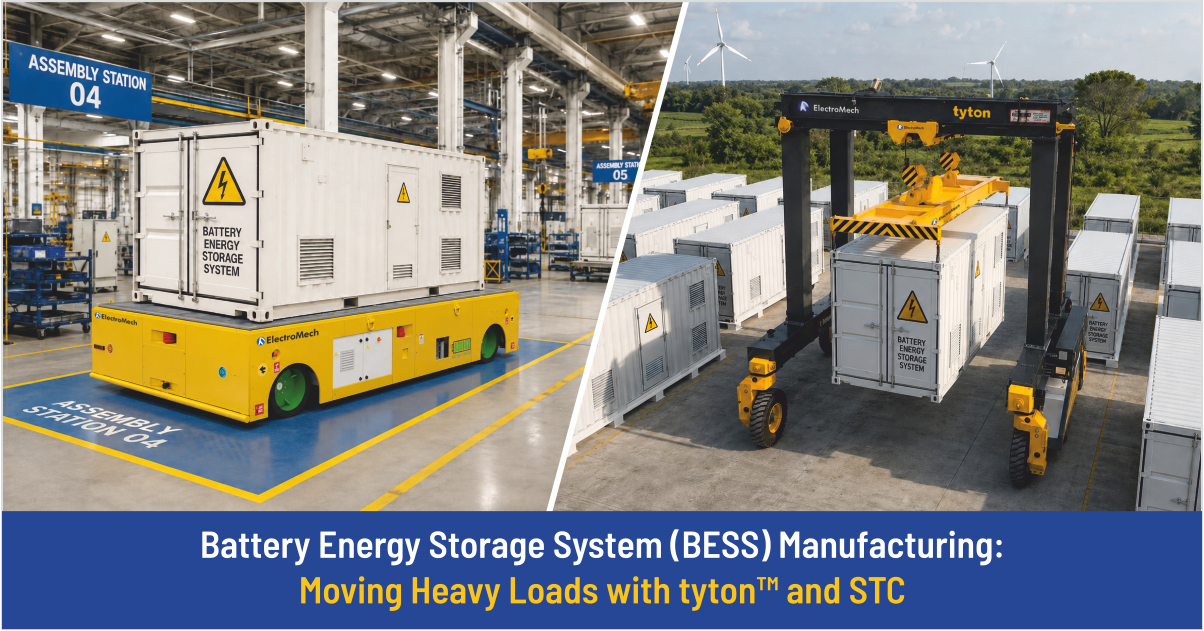
ElectroMech addresses these requirements with tyton™ for outdoor lifting and yard movement, and STC for carrying and positioning containers between production stations.
Each machine performs a defined role. Planned transfer points connect them into one coordinated handling process, with the arrangement adapted to the facility’s layout and operating requirements.
Here is how they support a container’s journey through production.
Receiving the Empty Container
tyton™ lifts the empty enclosure from the incoming trailer and places it in the receiving area. It then supports movement towards the assembly entrance.
At the designated transfer point, the enclosure is transferred onto the STC, which carries it to the first assembly station.
Moving Between Workstations
As assembly progresses, the STC moves the container to the next station and positions it for the work ahead. This includes movement between assembly, testing and inspection areas.
A dedicated return route allows the STC to travel back for its next collection after delivering a container. Including this route in the layout helps organise both loaded movement and return travel.
Handling the Completed Unit
After assembly and testing, the completed BESS container leaves the production area and enters the finished-goods handling flow.
tyton™ handles outdoor movement to storage and loads the unit onto an outbound trailer when it is ready for shipment. A finished-goods area provides space for completed containers to wait without occupying an assembly station.
Features That Support BESS Container Handling
tyton™: Outdoor Lifting and Yard Movement
ElectroMech’s tyton™ electric rubber-tyred gantry crane is a self-propelled, electrically powered solution for lifting and moving heavy loads.
Features relevant to BESS yard handling include:
- Four-wheel steering: helps manoeuvre between receiving, storage and loading areas.
- Patented EM Steersense technology: electronically synchronises wheel movement during steering.
- Variable-speed electric drives: support-controlled travel and positioning.
- All-electric operation without hydraulics: removes hydraulic-system servicing from maintenance requirements.
- Modular structure and plug-and-play wiring: support dismantling and relocation when required.
tyton™ can operate on concrete, asphalt and compacted soil, with gradients up to 5%. Suitability for a particular route depends on the selected configuration, load and site conditions.
STC: Indoor Transfer and Container Positioning
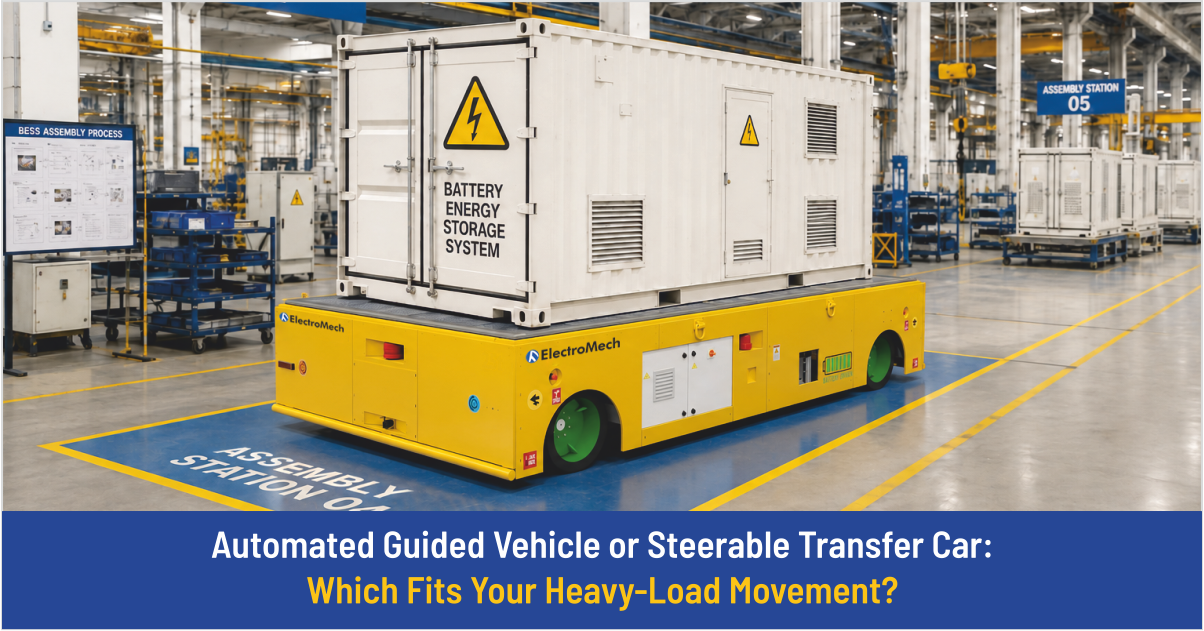
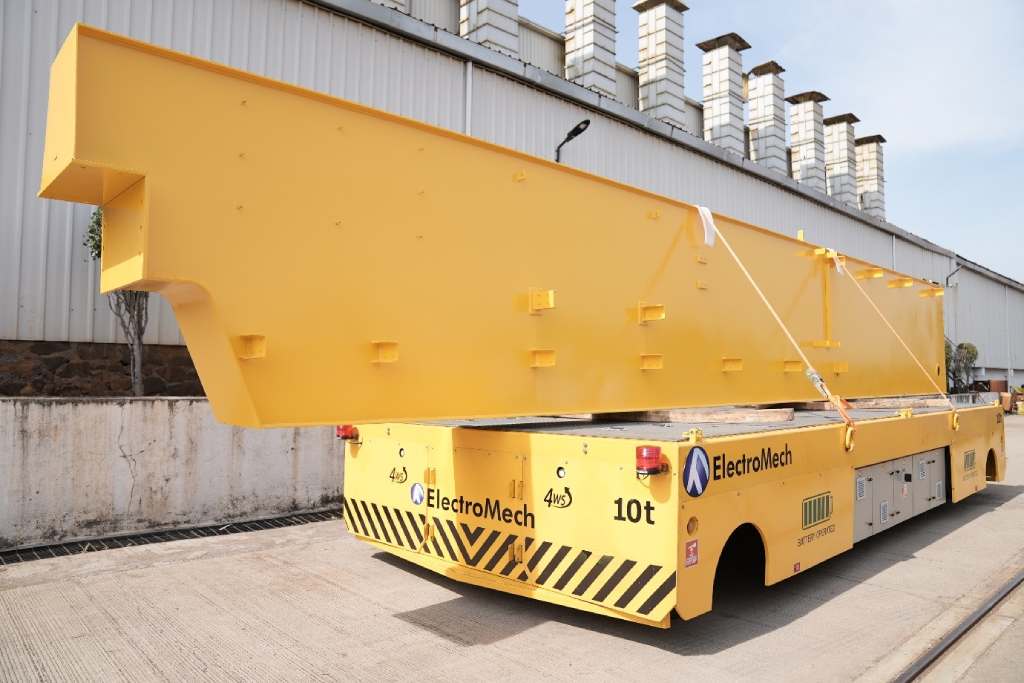
The STC is a self-driven, electrically powered transporter. It carries the enclosure on its platform and positions it at the required production station.
Its relevant features include:
- Capacities up to 100 tonnes: with selection based on the actual load and application.
- Two-wheel steering or optional four-wheel steering: to suit aisle widths and turning space.
- Controlled movement and positioning sensors: help place containers at assembly, testing and inspection stations.
- Radio remote control: allows the operator to control movement from a suitable viewing position.
- Emergency stops, movement alarms and programmed safety interlocks: support-controlled operation around production areas.
The transporter must be selected to carry both the empty enclosure and the fully assembled unit. Although the handling arrangement described here uses the STC indoors, it can also serve outdoor applications where the configuration and site conditions are suitable.
What Should BESS Manufacturers Consider?
For battery energy storage system manufacturers in India, evaluating the full movement route helps establish how tyton™ and STC will work within the plant.
The main considerations include:
- Container dimensions and weight at each stage, including the completed unit.
- Approved lifting and support points throughout assembly.
- Doorway, aisle and workstation clearances along the route.
- Floor and yard conditions, including gradients and load-bearing suitability.
- Transfer locations between tyton™ and STC.
- Movement frequency, return travel and charging arrangements.
For example, a narrow assembly aisle may make the STC’s steering configuration a key selection factor. An outdoor route with a gradient requires an assessment of the crane configuration, load and surface conditions.
Container drawings, load details and a plant layout provide a useful starting point for evaluating these requirements together.
Frequently Asked Questions
How are BESS containers handled during manufacturing?
An empty enclosure is unloaded from the incoming trailer and moved towards assembly. It is then carried and positioned at assembly, testing and inspection stations. Once completed, the container moves to finished-goods storage or outbound loading. ElectroMech’s tyton™ handles outdoor lifting and yard movement, while STC supports transport between production stations.
What equipment moves heavy BESS containers inside a factory?
A Steerable Transfer Car (STC) can carry heavy BESS containers between workstations and position them for the next operation. Its capacity, steering configuration and platform arrangement must suit the container’s weight, support points and available factory space.
What is the difference between tyton™ and STC?
tyton™ is an electric rubber-tyred gantry crane that lifts and moves loads. STC is an electrically powered transporter that carries loads supported on its platform. In the BESS handling arrangement described here, tyton™ serves outdoor lifting and yard operations, while STC moves containers through indoor production.
What is the maximum capacity of an STC?
ElectroMech’s STC range offers capacities up to 100 tonnes. The appropriate capacity depends on the container’s weight throughout production, its load distribution and the application requirements.
Can tyton™ operate on slopes or uneven ground?
tyton™ can operate on gradients up to 5% and on suitable concrete, asphalt and compacted-soil surfaces. This does not mean every uneven surface is suitable. Route conditions must be assessed against the selected crane configuration and load.
What details do I need to share to select handling equipment for BESS containers?
Share container drawings, dimensions, weights at different production stages, and approved lifting and support points. A plant layout showing workstations, doorways, aisles, transfer locations and outdoor routes is also useful. Include surface conditions, gradients and expected movement frequency to help establish a suitable configuration.
Connecting Yard Handling with BESS Production
Manufacturing containerised energy storage systems requires a handling arrangement that accommodates changing loads and connects the yard with the production floor.
ElectroMech’s tyton™ and STC bring together outdoor lifting, station-to-station transport and controlled positioning, supporting the container through each stage of manufacturing.
Planning or expanding a BESS facility? Connect with ElectroMech to discuss tyton™ and STC for your container-handling requirements.
Also Read: