Moving a heavy assembly between workstations requires equipment that suits its dimensions, support points and travel route. The next question is how that movement should be controlled: does the application require automatically assigned journeys, or an operator directing each transfer?
An automated guided vehicle (AGV) can support repeated transport tasks through automatic guidance. ElectroMech’s Steerable Transfer Car (STC) provides battery-powered, operator-controlled movement for heavy loads across workshops, factories and yards.
Both deserve consideration against the complete transfer requirement, from collecting the load to delivering it where the next process needs it.
AGV and STC: The Key Difference
An automated guided vehicle travels along defined routes without an operator steering each journey. Its guidance technology establishes its position, while controls manage movement. Depending on the installation, the system can receive transport orders from warehouse or production software.
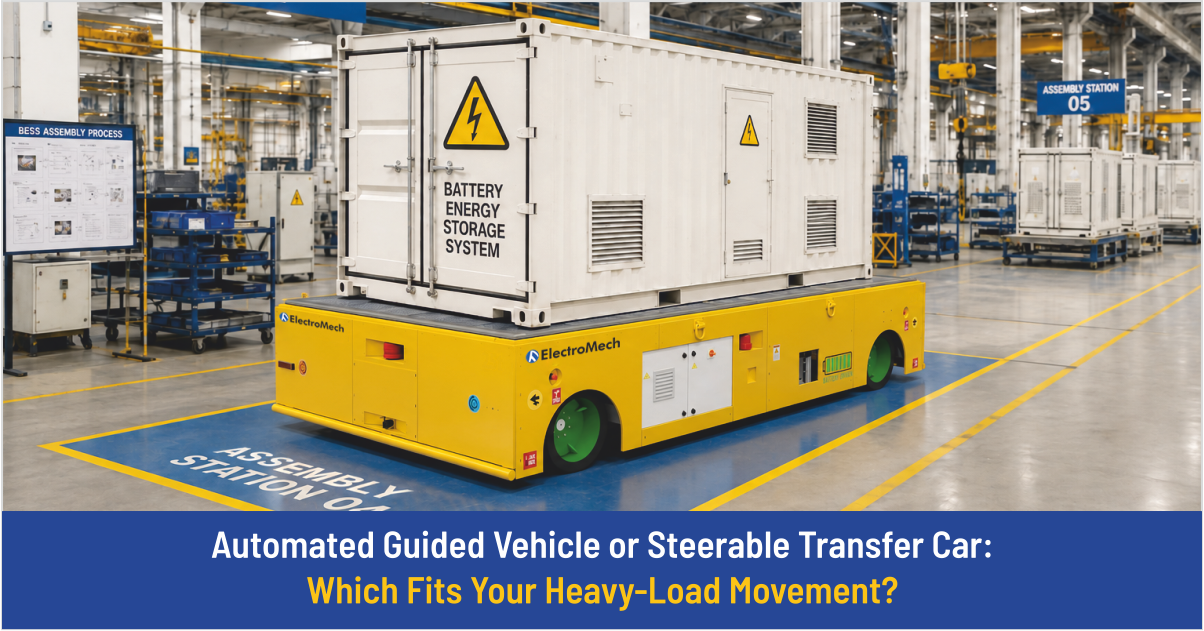
ElectroMech’s STC uses radio remote control, with an operator’s cabin available as an option. An operator directs its travel. Its rubber tyres and steering allow movement without a fixed rail route, subject to suitable floor and operating conditions.
The distinction is the control arrangement. Heavy loads can be handled by specially engineered AGVs as well as suitable transfer cars. The choice depends on load-handling requirements and the level of automation needed.
Heavy-Load Movement Challenges and How STC Addresses Them
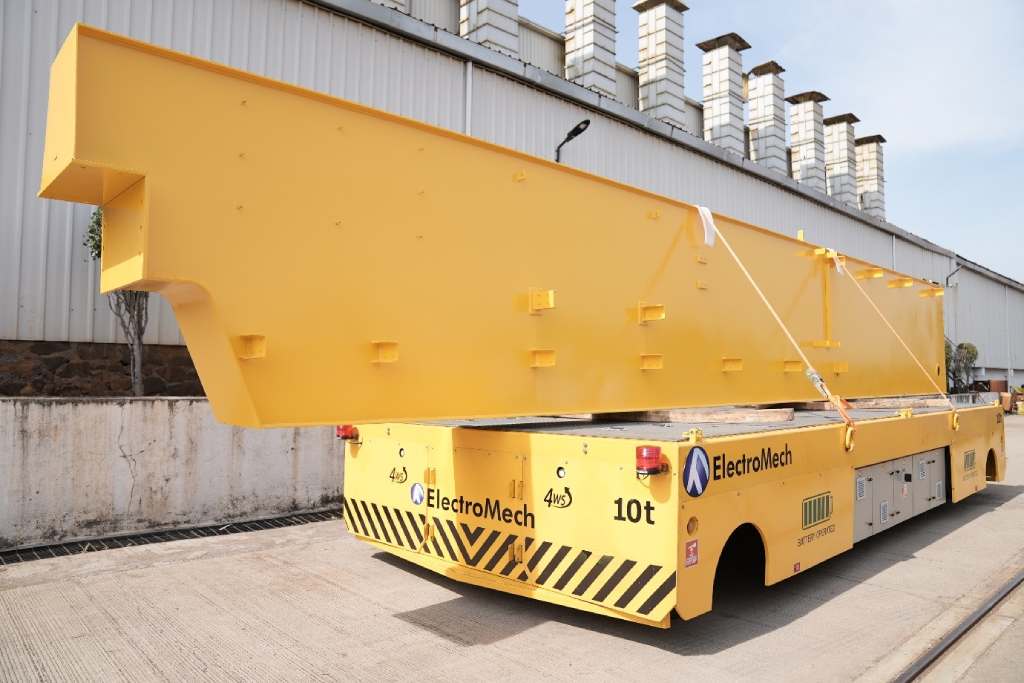
Large assemblies can require substantial supporting surfaces, clearance through turns and access to different work areas. ElectroMech’s STC offers features that address these practical requirements.
Supporting Large or Irregular Loads
A load may be within a vehicle’s rated capacity yet require a different platform size or support arrangement. Overhanging sections and uneven weight distribution also need consideration.
STC platform dimensions can be customised to the application. This allows the supporting surface to be assessed against the assembly’s footprint and designated support points. Any fixtures needed to support or secure the load must be defined during the engineering assessment.
Negotiating Turns and Workstation Access
Straight-line clearance does not establish whether a loaded vehicle can negotiate a corner. The assembly’s overhang and orientation affect the space needed to enter a manufacturing bay or approach a workstation.
STC steering configurations, including optional four-wheel steering, can be evaluated against these requirements. The route assessment should consider the movement of the vehicle and load together.
Travelling Between Work Areas Without Rails
A fixed rail route may not suit transfers between several bays or destinations spread across a facility.
STC’s rubber tyres and onboard battery support travel without fixed rails or a trailing travel-power cable. The selected configuration must still suit the floor, gradients and operating environment along the route.
Directing Loads to Changing Destinations
The next workstation may depend on production progress or available space. In an operator-controlled application, the destination can be selected for each transfer.
STC’s radio remote control allows the operator to direct the vehicle to the required location. Route access and suitable loading and unloading arrangements must be established for each destination.
Where an Automated Guided Vehicle Fits
An automated guided vehicle for material handling is worth evaluating when the application requires automatic transport between defined locations. Typical tasks include recurring pallet transfers, material delivery to production stations and movement between manufacturing and storage areas.
An automated guided vehicle system combines the vehicle with guidance, task controls and pickup and delivery arrangements. Guidance methods include following magnetic paths and using laser scanners with reference points such as reflectors. Infrastructure requirements depend on the selected technology.
The vehicle must also coordinate with the process. A transport order needs a ready load at the pickup point and an available destination. Charging arrangements and recovery from interrupted journeys form part of the system design.
Common Types of Automated Guided Vehicle
Vehicle designs differ according to how they handle materials:
- Towing AGVs pull carts or trailers for material-delivery rounds.
- Fork-type AGVs collect and deliver compatible pallets or loads designed for fork access.
- Unit-load AGVs carry materials on a platform or supporting arrangement.
- Special-purpose heavy-load AGVs are engineered for loads such as coils, dies, fixtures and oversized containers.
The appropriate design depends on the load and transfer method. Automatic guidance does not replace the need for suitable support, stability and clearance.
Two Applications, Different Movement Requirements
The following examples are illustrative.
Repeated Pallet Transfers to a Collection Point
A packing station sends pallets to the same collection point throughout a shift. Load dimensions, pickup arrangements and destinations remain consistent.
An automated guided vehicle in a warehouse can be evaluated for this task. The assessment should establish how journeys are triggered, how the pallet is collected and what happens if the collection point is occupied.
Here, automatic task execution is a central requirement.
A Fabricated Assembly Moving Between Manufacturing Bays
A large assembly moves to the next available workstation. Its footprint requires a suitable platform, and its route includes turns through shared work areas.
An operator-controlled STC may suit this requirement if its load support, steering and operating configuration match the application. The assessment must also define how the assembly is placed on the platform and removed at its destination.
If automatic movement is required, a heavy-load AGV assessment must additionally address navigation, destination assignment and interaction with the workstations.
Comparing the Options for Your Application
| Requirement | AGV evaluation | Operator-controlled STC evaluation |
| Journey control | Define automatic task assignment, guidance and destination handling. | Define how the operator directs and monitors each transfer. |
| Load support | Confirm a suitable vehicle design and load-handling arrangement. | Confirm platform dimensions, capacity and support requirements. |
| Route access | Assess navigation infrastructure, clearances and traffic interaction. | Assess steering, loaded turning space and floor suitability. |
| Pickup and delivery | Define any automatic transfer equipment and station interfaces. | Define loading, unloading and the required delivery position. |
| Operating schedule | Assess charging, task coordination and interruption recovery. | Assess charging, operator availability and transfer frequency. |
When comparing proposals from automated guided vehicle manufacturers or evaluating an STC, ask suppliers to explain the complete journey using your actual load and layout.
For example, carrying an assembly to a work area and presenting it in a defined position for the next operation are different requirements. Stating that distinction early helps establish the equipment and station arrangements needed.
Frequently Asked Questions
1. What is a steerable transfer car?
A steerable transfer car is a powered vehicle that carries loads on a supporting platform and can steer between work areas. ElectroMech’s STC uses rubber tyres, battery power and operator controls to transport heavy loads across suitable factory floors and yard surfaces.
2. What is the difference between an AGV and a steerable transfer car?
An automated guided vehicle uses guidance technology to travel without an operator steering each journey. ElectroMech’s documented STC configuration is operator-controlled through a radio remote, with an operator’s cabin available as an option. The key difference is how movement is controlled, rather than the load’s weight alone.
3. Can an STC move heavy loads without rails?
Yes. ElectroMech’s STC travels on rubber tyres without a fixed rail route. Its suitability depends on the selected configuration, load, floor condition, gradients and available clearance.
4. When should I choose an AGV over an operator-controlled transfer car?
Consider an AGV when your application requires automatic transport, particularly for repeated journeys between defined pickup and delivery points. Selection also depends on load compatibility, station interfaces, traffic conditions and how the system handles interruptions.
5. What information do suppliers need to recommend a heavy-load transfer solution?
Provide:
- Load weight, dimensions, support points and centre of gravity, where known.
- Changes in load weight or dimensions during production.
- Route layout, turning clearances, floor conditions and gradients.
- Loading, unloading and delivery-position requirements.
- Transfer frequency, shift pattern and required level of automation.
6. Is an STC battery-powered?
Yes. ElectroMech’s STC uses an onboard battery for powered travel. Battery selection and charging arrangements should be confirmed for the operating schedule and specified configuration.
How to Choose the Right Heavy-Load Transfer Solution
The right solution must support the load, negotiate the route and deliver the required level of control.
An AGV can address transport tasks that require guided, automatic movement. ElectroMech’s operator-controlled STC provides an option for heavy-load transfers where platform support, steering and operator-directed travel match the application.
Planning heavy-load movement between work areas? Connect with ElectroMech to discuss your load dimensions, travel route and operating requirements, and evaluate STC suitability for your facility.