
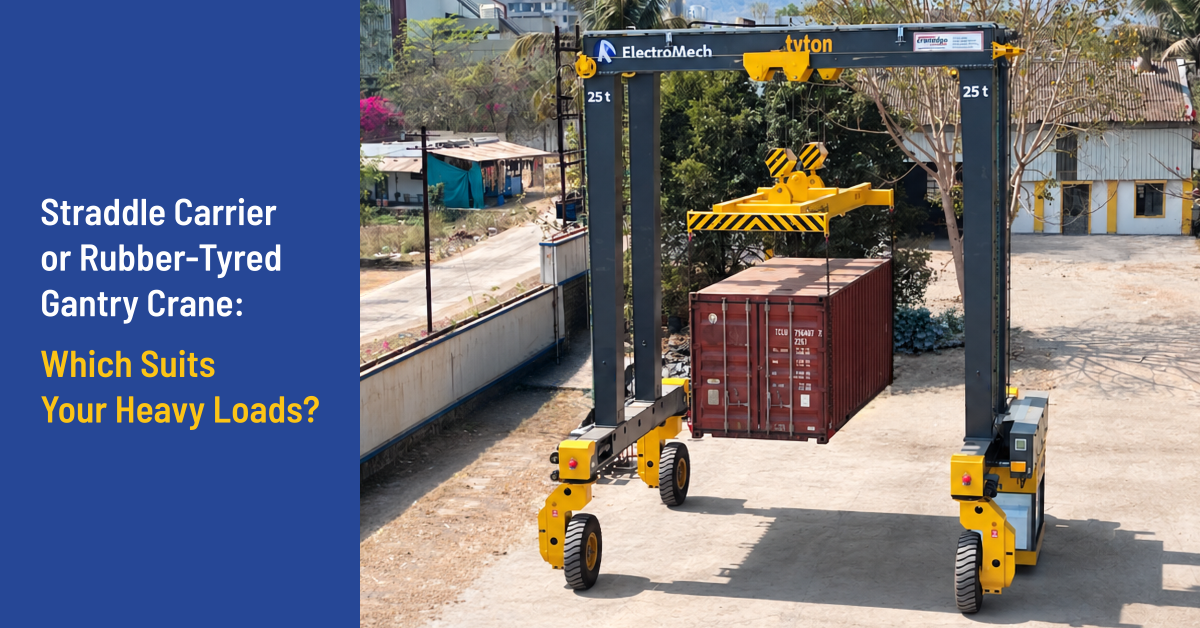
A straddle carrier combines lifting and transport in one mobile machine. Its frame passes over the load, allowing it to lift, carry and place containers or other heavy items within the space between its legs.
For industrial operations, the main question is whether this arrangement suits the load and its journey. A container moving between storage locations has different handling requirements from a fabricated assembly that needs to be lifted, moved and positioned at several work areas.
A rubber-tyred gantry cranecan also provide mobile lifting without fixed travel rails. Understanding the differences helps determine which equipment arrangement fits your application, including where ElectroMech’s tyton™ belongs in the evaluation.
How a Straddle Carrier Handles a Load
A straddle carrier approaches with its wheels on either side of the load. Its lifting equipment connects to the load, raises it clear of the ground and holds it within the frame during travel. At the destination, the carrier lowers the load onto the designated surface or supports.
The lifting arrangement depends on what the machine handles. Container applications can use a spreader, a lifting attachment that connects to the container’s designated lifting points. Other industrial loads require an arrangement suited to their shape, weight distribution and approved lifting points.
This makes the space inside the frame an important part of selection. Rated capacity alone does not establish suitability. The load and its lifting attachments must fit within the machine’s working dimensions, with sufficient clearance for lifting and travel.
Where an Industrial Straddle Carrier Fits
An industrial straddle carrier is worth evaluating when heavy or oversized loads need to move between locations beyond the coverage of a fixed crane.
Applications can include container handling, steel fabrication, precast concrete and large manufactured assemblies. However, suitability depends on the individual load and site, rather than the industry name alone.
Consider an illustrative example: a fabricated steel assembly needs to move from an outdoor storage area to a finishing bay. A carrier capable of lifting and transporting that assembly could combine both tasks in one movement. The assessment would still need to establish whether the carrier can approach the assembly, connect to its lifting points and complete the route with adequate clearance.
The value lies in matching the machine to the complete transfer, from picking up the load to placing it where the next activity requires it.
Straddle Carrier and Rubber-Tyred Gantry Crane: What Is the Difference?
Both equipment types can use a wheeled frame that spans a load. Their appearance alone does not explain how they will handle it.
Straddle carriers commonly focus on picking up and carrying loads within their frame. Depending on the model, container carriers may also stack containers.
A rubber-tyred gantry crane is a crane mounted on tyres rather than fixed travel rails. Its hoist lifts the load, while trolley travel can move the lifting point across the crane’s span. Crane travel allows the equipment to move through the approved operating area.
That movement across the span can matter when the lifting or placement position varies. For example, an application may require a load to be picked up at one position within the crane’s working width and placed at another.
Terminology varies between suppliers. Equipment described as a “straddle carrier crane” or “straddle carrier truck” should therefore be assessed through its actual lifting arrangement, travel capabilities and operating limits.
What Determines the Right Equipment Arrangement?
Load dimensions and lifting points
The assessment should include the load’s length, width, height and centre of gravity, meaning the point around which its weight is balanced. Lifting attachments also occupy space and contribute to the total lifted weight.
For long or irregular assemblies, the location of the lifting points can influence the required arrangement as much as the load’s overall weight.
Pickup and placement requirements
Lifting a load clear of the ground is different from lifting it onto a trailer or over an obstruction. The required lift height must account for the load, attachments and placement level.
Likewise, carrying a load between two open areas differs from positioning it within a confined bay. The final placement requirement should be part of equipment selection from the outset.
Route and ground conditions
Tyre-mounted equipment avoids the need for fixed travel rails, but it still requires a suitable operating surface.
Ground bearing capacity, gradients, drainage channels, doorways and turning space can affect the permitted route. The assessment must cover the equipment while carrying the intended load, including the space occupied during turns.
Frequency of movement
A machine that suits an occasional transfer may not suit a production process with frequent movements. Travel distance, lifting time and competing handling tasks all influence whether the equipment can support the required schedule.
When comparing straddle carrier manufacturers, providing these application details helps suppliers propose equipment against the same operating requirement.
Electric Straddle Carrier: Check What “Electric” Means
An electric straddle carrier should be evaluated through both its drive system and its energy source.
Electric motors may power the machine’s movements, while electricity is supplied by batteries or an onboard generator, depending on the design. These arrangements have different implications for charging, fuel use and emissions at the operating site.
If battery operation is required, the discussion should cover the expected work schedule, charging arrangements and available charging time. The word “electric” alone does not confirm that a machine is battery-powered or produces no exhaust emissions during operation.
How ElectroMech’s tyton™ Addresses These Requirements
ElectroMech’s tyton™ is an electrically driven rubber-tyred gantry crane designed and manufactured in-house. Its tyre-mounted structure provides mobile lifting without permanently fixed travel rails. It offers an option for handling requirements that extend across factory or yard locations.
Mobile lifting across work areas
Removing the requirement for fixed travel rails allows tyton™ to serve different pickup and placement locations along a suitable operating route.
For example, in an illustrative fabrication-yard application, a completed assembly needs to be lifted from storage, moved to a loading area and placed onto a trailer. A suitable tyton™ configuration could undertake these activities within one handling sequence.
Lifting and positioning within the crane’s span
tyton™ combines hoisting, trolley movement across the span and crane travel. These motions support applications where the lifting point needs to move within the working width as well as between locations.
This matters when collecting a component from supports or aligning it with its destination.
A configuration matched to the load
ElectroMech offers single-girder tyton™ RTG cranesanddouble-girder tyton™ RTG cranes. The double-girder offering supports application-specific spans and lift heights, helping accommodate the load and placement requirements.
Electric motions and remote operation
ElectroMech specifies electrically driven motions without hydraulics and radio remote control. Remote operation allows the operator to direct handling from a suitable viewing position.
Battery power and four-wheel steering are listed as optional features. Their inclusion should follow the operating schedule and available manoeuvring space.
Frequently Asked Questions
Is tyton™ a straddle carrier?
ElectroMech identifies tyton™ as an electrically driven rubber-tyred gantry crane. Although both equipment types can use a mobile frame that spans a load, their lifting and positioning arrangements can differ. Compare the proposed machines through their actual capabilities rather than their appearance or category name alone.
Can container-handling equipment also lift fabricated structures?
Only if its frame, lifting system and attachments suit those structures. Container-handling capability does not establish suitability for every industrial load. The assessment must cover the component’s dimensions, weight distribution and approved lifting points.
What should a supplier receive when evaluating an application?
Share the load weight and dimensions, lifting-point drawings, pickup and placement heights, route layout and expected movement frequency. Include details of the operating surface and any restricted access. This helps suppliers assess the complete task against a common requirement.
Can one machine handle several component types?
Potentially, but the proposed configuration must accommodate the full range. Different components may need different attachments, clearances or lifting arrangements. Include the largest dimensions and most demanding placement requirement, as well as the heaviest load.
Choose Around the Load and Its Journey
A straddle carrier and a rubber-tyred gantry crane may both deserve consideration for mobile heavy-load handling. The right choice depends on how the equipment must lift, carry and place the load within the available space.
Evaluating mobile lifting for your facility? Connect with ElectroMech to discuss your load details, movement route and placement requirements, and assess whether tyton™ suits your application.